Do You Need a New Bot? Run the CRAM Test
By Scott Vradenburg
How do I know when I need a new bot?
Short answer: you probably don't. Not yet.
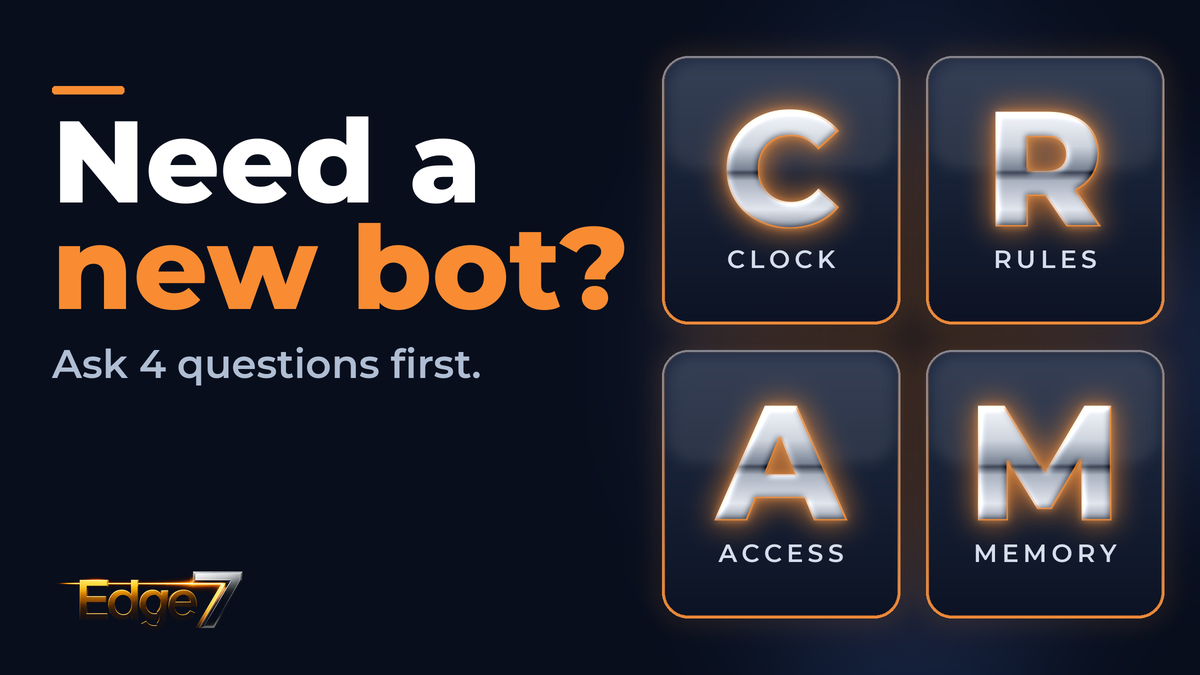
Start with one bot. Before you build another one, CRAM it. CRAM stands for four yes-or-no questions: Clock, Rules, Access, Memory. If you answer yes to Access, or yes to any two of the others, build the new bot. If not, teach your current bot a new skill or give it a routine.
What I mean by "bot"
A bot is an AI assistant with one job, its own chat, its own instructions, and its own memory of how you like that job done.
I use Grok Bot, xAI's desktop assistant app. In Grok Bot, each bot can also have skills (saved, step-by-step instructions for a task) and routines (a schedule or trigger that tells the bot to do something without being asked). All my bots share one cloud computer, and they can message each other.
Why one bot is the right default
Every new bot is one more thing to set up and check on. A bot that knows you well and does five related things is usually better than five bots that each know you a little.
This isn't just my opinion. xAI's own help docs say to start with the smallest useful team of bots. OpenAI's guide to building agents ("agent" is the industry word for an AI that takes actions) says to get the most out of a single one first. Anthropic says to add complexity only when it clearly improves results.
So the question isn't "could this be its own bot?" The question is "does this work break the bot I already have?" That's what CRAM checks.
The CRAM test
Answer each one yes or no. If you have to think hard about it, the answer is probably no. These track closely with the reasons xAI's own docs give for a separate bot.
C is for Clock. Will it run on its own schedule, for a job your current bot doesn't own?
Some work runs while you're away, like daily posts. If the new work has its own timetable and serves a different job, that's a yes. A routine that serves your current bot's existing job is a no. Just add the routine.
R is for Rules. Would its standing instructions contradict your current bot's?
Standing instructions are the rules a bot always follows. If your current bot's rules say "never post anything publicly" and the new job is posting to LinkedIn every day, that's a yes. Same if the new job needs a different voice (casual and public versus careful and internal). One bot can't follow two opposite rules. It will get one of them wrong.
A is for Access. Does it need accounts, data, or approval rules your current bot shouldn't have?
Think bank or brokerage accounts, client files, payroll, anything with real money or a duty of confidentiality. If the new work touches something your current bot has no business touching, that's a yes. A separate bot gives that work its own written limits ("never place a trade without my approval") and keeps those details out of the other bot's chat and memory.
M is for Memory. Would it need to remember a whole set of facts your current bot would never use?
Bots remember your preferences and important facts over time. If the new job means filling that memory with things unrelated to the first job (your kids' food allergies sitting next to your client pipeline), that's a yes. Mixed memory makes both jobs worse.
How to score your CRAM
- A is yes: build the new bot. Access is the one letter that decides it alone, because mixing sensitive access is the mistake that's hardest to undo.
- Two or more of C, R, or M are yes: build it. The two jobs are pulling in different directions.
- Only one of C, R, or M is yes: try a skill or routine in your current bot first. If it keeps getting things wrong after corrections, build the new bot.
- No yeses: keep it in your current bot.
Signs you don't need a new bot
Most "I need a new bot" moments are really one of these:
- It's a new skill. You want your bot to do a new task the same way every time, like summarizing an engagement letter in a set format. Save it as a skill. In Grok Bot, a skill can be turned on for any bot that needs it.
- It's a new routine. You want your current bot to do its current job on a schedule, like a Monday summary. That's a routine in your current bot.
- It's a one-off. You need something once. Just ask your current bot. A bot for a one-time task is clutter.
- It's a category, not a job. "I want a marketing bot" is a category. A job sounds like "draft three posts a week from my client FAQs." If you can't describe the job in one sentence, it isn't ready to be a bot.
An example from my own team
I run thirteen bots now: a chief of staff that coordinates the others, a developer, a finance bot, an inbox sorter, a family meal planner, and more. That sounds like the opposite of my advice. It isn't. Each one has a job that is clearly different from the rest.
Here's one decision I thought hard about. Maui researches prospects for Edge7. Tigger posts to social media. Both are "marketing," so it would have been easy to make them one bot.
So I CRAMmed it. Clock: Tigger works off a posting calendar. Maui's research doesn't. Yes. Rules: Maui's research notes are private and should never be published. Tigger's whole job is publishing, in a public voice. Yes. Memory: Maui remembers people and firms. Tigger remembers what we've posted and what's next. Yes. Three yeses. Two bots.
Trading was even simpler. Tiana runs my trading desk and touches my brokerage accounts. No other bot should be anywhere near that. A was a yes, and that settled it.
One honest caveat about privacy
Separate bots are not separate safes. On Grok Bot, my bots share one computer. If I sign into a website with one bot, the others can reach it too. xAI says this plainly in its own guide.
So a separate bot gives sensitive work its own rules, its own conversation, and its own memory. That matters. But the real lock on client data should stay where it already is: the permissions in your client portal, your document system, and your accounts. Don't sign a bot into anything you wouldn't want every bot to reach. And keep sending, paying, and deleting behind your approval.
The CRAM checklist
Screenshot this.
Next time you're tempted to build another bot, CRAM it first. And if you'd like a second set of eyes on your own setup, that's the work I do at Edge7. You can find me at edge7consulting.com.
Questions or pushback? scott@edge7consulting.com
Start a conversation →